
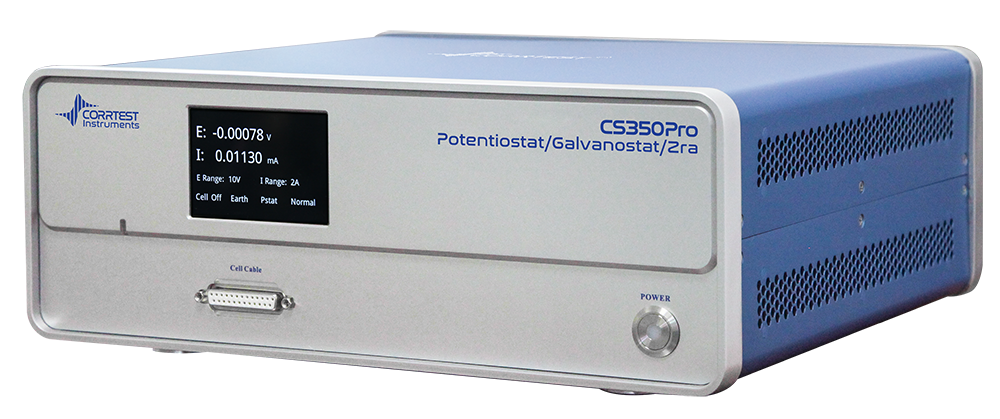
Single-channel potentiostat/galvanostat with EIS Model CS350Pro consists of a DDS arbitrary function generator, a potentiostat/galvanostat and an FRA. With the help of built-in dual 24-bit Delta-sigma AD converters, it achieves excellent stability and high potential (1mV) and current(1pA) resolutions. With 40+ electrochemical techniques, CS350pro has been widely applied in corrosion, energy, material and analysis electrochemistry.
CS350Pro is an upgraded version of the conventional single-channel electrochemical workstation with outstanding stability and accuracy, advanced hardware, and fully functional software. EIS frequency can be as high as 5MHz.

-1(1).png)
Application
●Study of Energy materials (Li-ion battery, solar cell, fuel cell, supercapacitors), advanced functional materials
● Bioelectrochemistry, sensors, electrosynthesis, electrodeposition (electroplating), anodic oxidation, electrolysis
● Electrocatalysis (HER, OER, ORR, CO2RR, NRR)
● Corrosion study and corrosion resistance evaluation of metals; quick evaluation of corrosion inhibitors, coatings, and cathodic protection efficiency
Corrosion Electrochemistry
CS potentiostats/galvanostats support a variety of electrochemical techniques for corrosion, such as OCP recorder, potentiodynamic, EIS, cyclic polarization (CPP), LPR, hydrogen diffusion test, zero resistance ammeter (ZRA), electrochemical noise (ECN), etc.
Due to their high input impedance(1013Ω), they are especially suitable for EIS measurement of high-impedance systems like coating, concrete, and pure water.
.png)
Polarization curve of Ti-based amorphous alloy & stainless steel in 3%NaCl solution
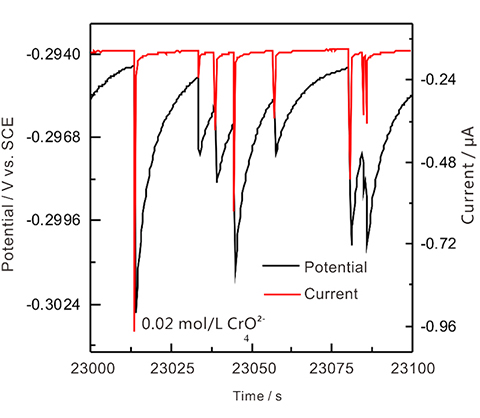
ECN of low-carbon steel in 0.05mol/LCl+0.1mol/LNaHCO3
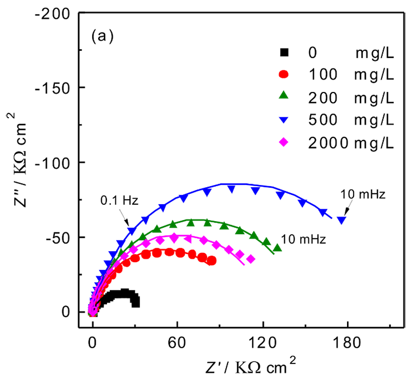
Salt spray aging test of high impedance coating
Energy & Battery testing
With versatile functions like linear sweep voltammetry (LSV), cyclic voltammetry (CV), galvanostatic charge/discharge (GCD),
EIS (including potentiostatic EIS and galvanostatic EIS)with precise IR compensation, CS potentiostats are widely used in supercapacitor, Li-ion batteries, Li-S batteries, fuel cell, solar cell, solid-state batteries, flow batteries, and metal-air batteries, etc.
.jpg)
CV curve of PPy supercapacitor in 0.5 mol/L H2SO4 solution
Electrocatalysis
Based on CV and LSV techniques, CS potentiostats can carry out long-term tests for ORR, OER, HER, and CO2 reduction, which is crucial for evaluating catalyst stability.
CS potentiostats can measure the half-wave potential (ORR) and overpotential (HER, OER) of catalysts and calculate the power density and energy density of Redox peaks.
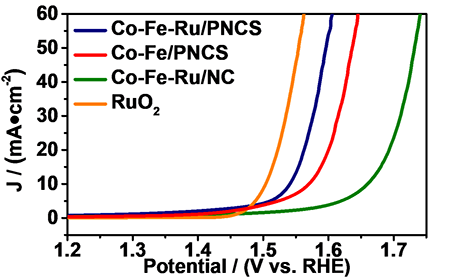
LSV curve of catalysts in alkaline solution
Analytical Electrochemistry
CS potentiostats include comprehensive voltammetric methods such as NPV, DPV, DNPV, SWV, and ACV, which make them ideal for quantitative analysis of trace elements via the intrinsic Voltammetry stripping techniques.
.png)
Stripping voltametric curves in solution of different Pb2+, Cd 2+,Zn2+ concentration
Technical Advantages
Switchable floating and earthing mode
All CS potentiostats/galvanostats can switch between the floating and earthing modes. This strategy is beneficial for studying electrochemical systems where the working electrodes are intrinsically ground, such as autoclaves, in-site concrete structures and multi-working electrodes requiring isolation, etc.
High-bandwidth EIS
With built-in digital FRA and arbitrary signal generator, as well as the high input impedance (1013W), the CS potentiostat is particularly suitable for EIS measurements of high-impedance systems (such as coating, membrane, concrete, etc.)
Based on the DC bias compensation technique, CS potentiostats can conduct EIS tests under charge/discharge state of batteries, making them suitable for ultra-low resistance systems, such as power batteries, fuel cells, water-splitting equipment, etc.
Multi electrode configurations
CS potentiostats support 2-, 3-, or 4-electrode configurations and can measure the galvanic current via built-in zero resistance ammeter circuits.
User-defined sequence test
CS Studio 6.0 for Windows software supports user-defined sequence tests (“combination test”), which can facilitate automatic testing according to user-defined experiment sequences.
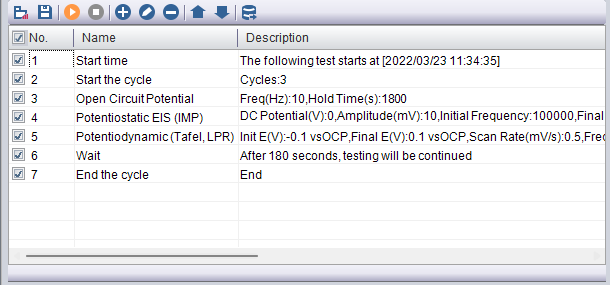
Sequence Test: corrosion tests
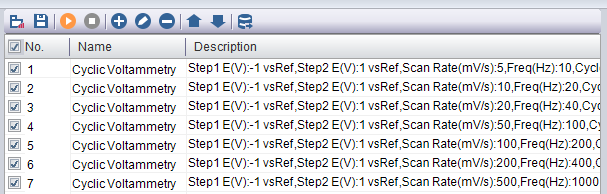
Sequence Test: Pseudocapacitor tests
Software development kit (SDK)
All CS potentiostats run under the control of CS Studio 6.0 for Windows (CSS 6.0). The CSS6.0 supports third-party languages, such as LabVIEW, C, C++, C#, VC, Python and others. Some API general interfaces and development examples can be supplied with the CS potentiostats. Through the SDK, customers can implement user-defined test methods.
Real-time data storage
CSS 6.0 saves experimental data timely, even if the experiment is accidentally interrupted by a power failure or computer shutdown. CSS 6.0 supports several data formats compatible with Originpro and Microsoft Excel.
Versatile data analysis
CSS 6.0 provides robust functions, including various electrochemical measurements and data analysis. It can complete Tafel plot fitting, CV derivation, integration and peak height analysis, EIS equivalent circuit fitting, etc.
3, 4 parameter polarization curve fitting.
EIS equivalent circuit fitting
Electrochemical noise spectrum analysis
Pseudo-capacitance calculation
GCD-specific capacitance, efficiency calculation
Mott-Schottky analysis
CV curve analysis
Activation/re-passivation curve analysis
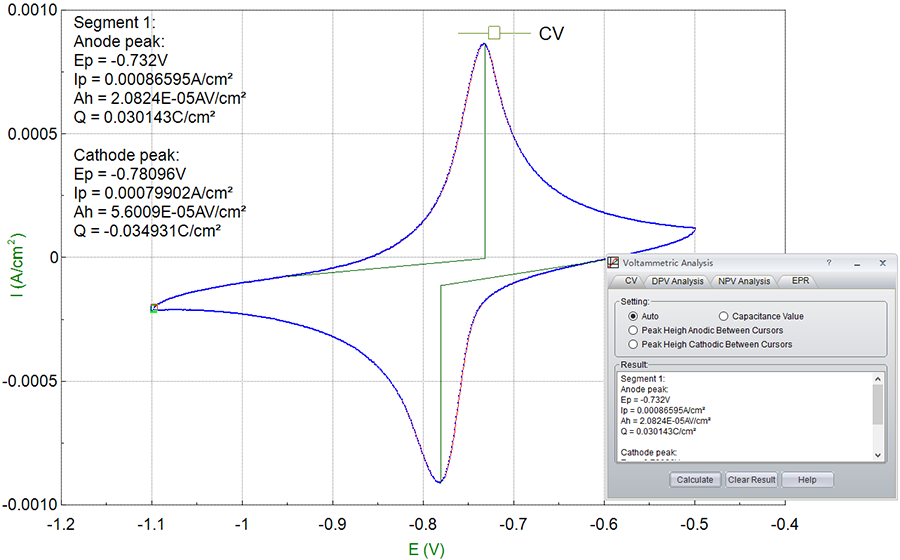
Software Features
Cyclic voltammetry:
CS studio software provides users a versatile smoothing/differential/ integration kit, which can complete the calculation of peak height, peak area and peak potential of CV curves. In CV technique, during the data analysis, there is function of selecting exact cycle(s) to show. You can choose to see a cycle or some cycles as you want. You can also export data or vector graph of an exact cycle or several cycles.
Tafel plot and corrosion rate:
CS studio also provides powerful non-linear fitting on Butler-Volmer equation of polarization curve. It can calculate Tafel slope, corrosion current density, limitation current, polarization resistance, corrosion rate. It can also calculate the power spectrum density, noise resistance and noise spectrum resistance based on the electrochemical noise measurements.
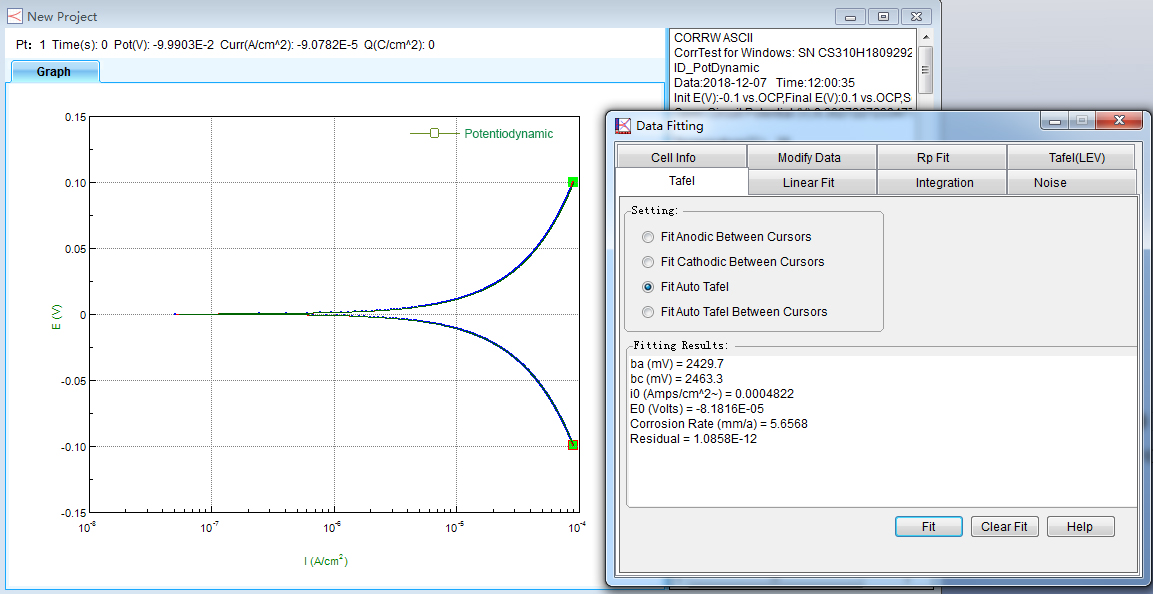
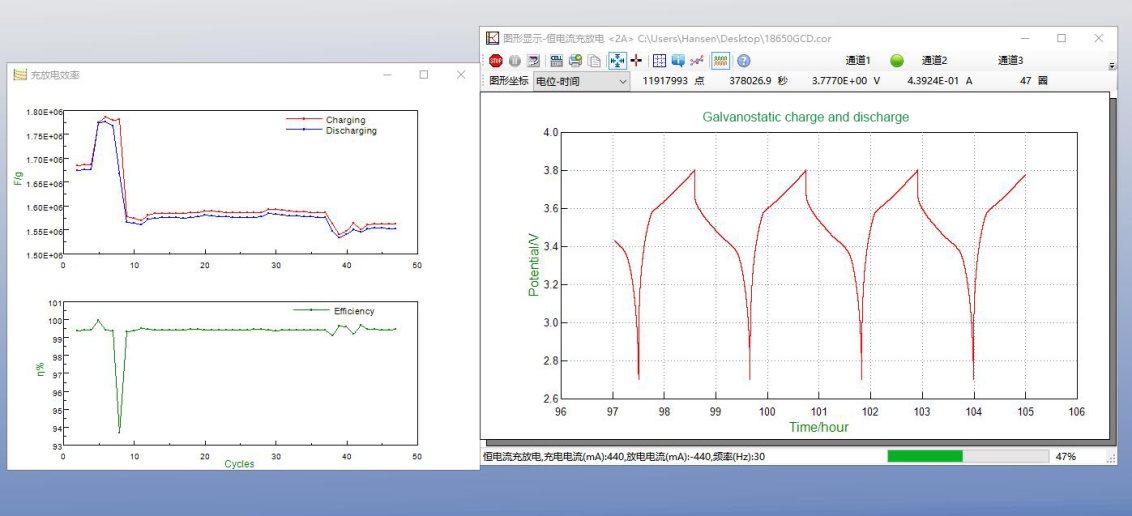
Battery Test and analysis:
charge & discharge efficiency, capacity, specific capacitance, charge & discharge energy.
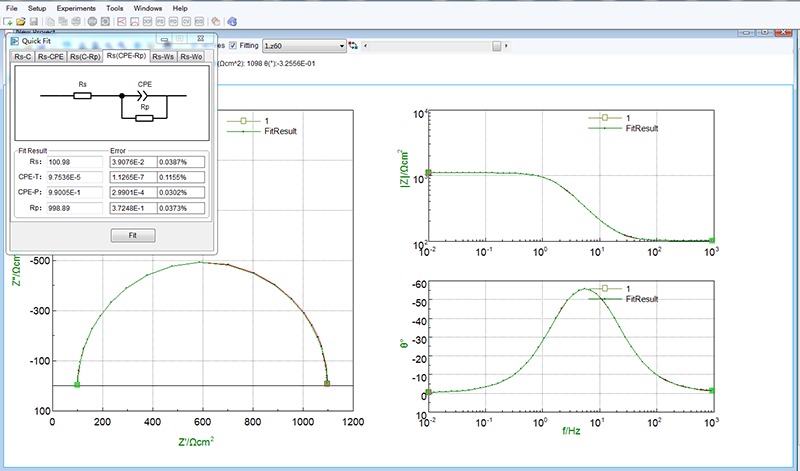
EIS analysis: Bode, Nyquist, Mott-Schottky plot
During EIS data analysis, there is built-in fitting function to draw the custom equivalent circuit.
Specifications | |
Support 2-, 3- or 4-electrode system | |
Potential control range: ±10V | Maximum current : ±2A |
Potential control accuracy: 0.1%×full range±1mV | Current control accuracy: 0.1%×full range |
Potential resolution: 1μV | Current sensitivity:1pA |
Rise time: <1μs (<10mA), <10μs (<2A) | Reference electrode input impedance:1013W||5pF |
Current range: 200pA~2A, 11 ranges | Potential range: ±200mV, ±2.5V, ±5V, ±10V, 4 ranges |
Compliance voltage:± 30V | CV and LSV scan rate: 0.001mV~10kV/s |
CA and CC pulse width: 0.0001~65,000s | Current increment during scan: 1mA@1A/ms |
Potential increment during scan: 0.02mV @1V/mS | SWV frequency: 0.001~100 kHz |
DPV and NPV pulse width: 0.001~100s | AD data acquisition:16bit@1 MHz,20bit@1 kHz |
DA Resolution:20bit | Minimum potential increment in CV: 0.02mV |
Current/potential range setting: Auto/ Manual | Low-pass filters: covering 7-decade |
Ground mode: Floating / Earthing, support ZRA | Interface: Ethernet & USB |
Operating System: Windows 10/11 | Power: 90~240V AC 50/60Hz |
Weight / Measurements: 6.5kg, 36 x 30 x16 cm | |
EIS (Electrochemical Impedance Spectroscopy) | |
Signal generator | |
Frequency range:10μHz~5MHz | Signal resolution:0.1mV RMS |
Frequency accuracy: 0.1% | AC amplitude:1mV~2500mV |
DC Bias: -10~+10V | Output impedance: 50Ω |
Waveform: sine wave, triangular wave and square wave | Wave distortion: <1% |
Scanning mode: logarithmic/linear, increase/decrease | |
Signal analyzer | |
Integral time: minimum:10ms or the longest time of a cycle | Maximum:106 cycles or 105s |
Measurement delay: 0~105s | |
DC offset compensation | |
Potential automatic compensation range: -10V~+10V | Current compensation range: -2A~+2A |
Bandwidth: 8-decade frequency range, automatic and manual setting | |
Techniques– CS350pro
Stable polarization:
Open Circuit Potential (OCP), Potentiostatic (I-T curve), Galvanostatic,Potentiodynamic (Tafel plot), Galvanodynamic (DGP)
Transient Polarization:
Multi Potential Steps,Multi Current Steps,Potential Stair-Step (VSTEP),Galvanic Stair-Step (ISTEP)
Chrono Method:
Chronopotentiometry (CP), Chronoamperometry (CA), Chronocaulometry (CC)
Voltammetry:
Linear Sweep Voltammetry (LSV), Cylic Voltammetry (CV), Staircase Voltammetry (SCV), Square Wave Voltammetry (SWV), Differential Pulse Voltammetry (DPV), Normal Pulse Voltammetry (NPV), Differential Normal Pulse Voltammetry (DNPV), AC Voltammetry (ACV), 2nd harmonic AC Voltammetry (SHACV), Fourier Transform AC Voltammetry (FTACV)
Electrochemical Impedance Spectroscopy:
Potentiostatic EIS (Nyquist, Bode), Galvanostatic EIS, Potentiostatic EIS (Optional freq.), Galvanostatic EIS(Optional freq.), Mott-Schottky, Potentiostatic EIS vs. Time (Single freq.), Galvanostatic EIS vs. Time (Single freq.)
Corrosion Measurements:
Cyclic polarization curve (CPP), Linear polarization curve (LPR), Electrochemical Potentiokinetic Reactivation (EPR), Electrochemical Noise (EN), Zero resistance Ammeter (ZRA)
Battery testing:
Battery Charge and Discharge, Galvanostatic Charge and Discharge (GCD), Potentiostatic Charging and Discharging (PCD), Potentiostatic Intermittent Titration Technique (PITT), Galvanostatic Intermittent Titration Technique (GITT)
Amperometric:
Differential Pulse Amperometry (DPA),Double Differential Pulse Amperometry (DDPA),Triple Pulse Amperometry (TPA),Integrated Pulse Amperometric Detection (IPAD)
Stripping Voltammetry:
Potentiostatic Stripping,Linear Stripping,Staircase Stripping,Square Wave Stripping,Differential Pulse Voltammetry Stripping,Normal Pulse Voltammetry Stripping,Differential Normal Pulse Voltammetry Stripping
Extensions:
Data Logger,Electrochemical Stripping/ Deposition, Bulk Eletrolysis with Coulometry (BE), Rs Measurement
Application
●Study of Energy materials (Li-ion battery, solar cell, fuel cell, supercapacitors), advanced functional materials
● Bioelectrochemistry, sensors, electrosynthesis, electrodeposition (electroplating), anodic oxidation, electrolysis
● Electrocatalysis (HER, OER, ORR, CO2RR, NRR)
● Corrosion study and corrosion resistance evaluation of metals; quick evaluation of corrosion inhibitors, coatings, and cathodic protection efficiency
Corrosion Electrochemistry
CS potentiostats/galvanostats support a variety of electrochemical techniques for corrosion, such as OCP recorder, potentiodynamic, EIS, cyclic polarization (CPP), LPR, hydrogen diffusion test, zero resistance ammeter (ZRA), electrochemical noise (ECN), etc.
Due to their high input impedance(1013Ω), they are especially suitable for EIS measurement of high-impedance systems like coating, concrete, and pure water.
Polarization curve of Ti-based amorphous alloy & stainless steel in 3%NaCl solution
ECN of low-carbon steel in 0.05mol/LCl+0.1mol/LNaHCO3
Salt spray aging test of high impedance coating
Energy & Battery testing
With versatile functions like linear sweep voltammetry (LSV), cyclic voltammetry (CV), galvanostatic charge/discharge (GCD), EIS (including potentiostatic and galvanostatic modes) with precise IR compensation, CS potentiostats are widely used in supercapacitor, Li-ion batteries, Li-S batteries, fuel cell, solar cell, solid-state batteries, flow batteries, and metal-air batteries, etc.
CV curve of PPy supercapacitor in 0.5 mol/L H2SO4 solution
Analytical Electrochemistry
CS potentiostats include comprehensive voltammetric methods such as NPV, DPV, DNPV, SWV, and ACV, which make them ideal for quantitative analysis of trace elements via the intrinsic Voltammetry stripping techniques.
Stripping voltametric curves in solution of different Pb2+, Cd 2+,Zn2+ concentration
Electrocatalysis
Based on CV and LSV techniques, CS potentiostats can carry out long-term tests for ORR, OER, HER, and CO2 reduction, which is crucial for evaluating catalyst stability. In addition, the CS2350M bi-potentiostat and multichannel potentiostat specialize in Faradaic efficiency synchronous measurement.
CS potentiostats can measure the half-wave potential (ORR) and overpotential (HER, OER) of catalysts and calculate the power density and energy density of Redox peaks.
LSV curve of catalysts in alkaline solution
Electrochemical Sensor
Thanks to the high current sensitivity(100fA) and voltage resolution(1 mV), the CS potentiostat can be used for the R&D of biosensors and electrochemical sensors.
Technical Advantages
Switchable floating and earthing mode
All CS potentiostats/galvanostats can switch between the floating and earthing modes, and this strategy is beneficial for studying electrochemical systems in which the working electrodes are intrinsically ground, such as autoclaves, in-site concrete structures and multi-working electrodes requiring isolation, etc.
High-bandwidth EIS
With the help of built-in digital FRA and arbitrary signal generator, as well as the high input impedance (1013 W), the CS potentiostat is particularly suitable for EIS measurements of high-impedance systems (such as coating, membrane, concrete, etc.)
Based on the DC bias compensation technique, CS potentiostats can conduct EIS tests under different charge/discharge states of batteries, making them suitable for ultra-low resistance systems, such as power batteries, fuel cells, water-splitting equipment, etc.
Multi electrode configurations
CS potentiostats support 2-, 3-, or 4-electrode configurations and can measure the galvanic current via built-in zero resistance ammeter circuits.
Independent multiple channels
For CS 310X multi-channel potentiostat, each channel is completely independent. It can be used for the electrochemistry measurements of multiple cells or multiple working electrodes in a cell.
CS2350M Bipotentiostat/multi-channel potentiostat can be used for the RRDE test, dual-cell hydrogen diffusion test.
User-defined sequence test
CS Studio 6.0 for Windows software supports user-defined sequence tests (“combination test”), which can facilitate automatic testing according to user-defined experiment sequences.
Sequence Test: corrosion tests
Sequence Test: Pseudocapacitor tests
Power booster
Through CS2020B/CS2040B/CS2100B booster, the CS potentiostats can extend their output current up to ±20A/40A/100A, meeting the growing requirements in fuel cells, power batteries, electroplating etc
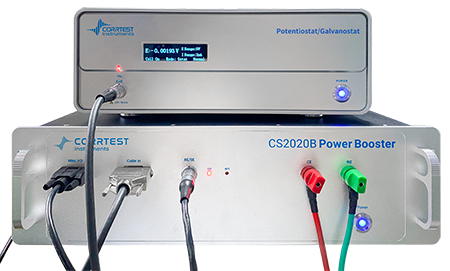
The compliance voltage of single-channel potentiostat can be customized(±30V),suitable for carbon/nitrogen electrochemical reduction.
With a multiplexer, the CS single-channel potentiostats can be extended to 16~32 channels for high throughput testing.
CS potentiostats can work with a CST520 arrayed electrode mapper to study the non-uniform corrosion of metal samples under deposits, coatings and anti-rust oils.
Software development kit(SDK)
All CS potentiostats run under the control of CS Studio 6.0 for Windows (CSS 6.0). The CSS6.0 supports third-party languages, such as LabVIEW, C, C++, C#, VC, Python and others. Some API general interfaces and development examples can be supplied with the CS potentiostats. Through the SDK, customers can implement user-defined test methods.
Real-time data storage
CSS 6.0 saves experimental data timely, even if the experiment is accidentally interrupted by a power failure or computer shutdown. CSS 6.0 supports several data formats compatible with Originpro and Microsoft Excel.
Versatile data analysis
CSS 6.0 provides robust functions, including various electrochemical measurements and data analysis. It can complete Tafel plot fitting, CV derivation, integration and peak height analysis, EIS equivalent circuit fitting, etc.
3, 4 parameter polarization curve fitting.
EIS fitting
Electrochemical noise spectrum analysis
Pseudo-capacitance calculation
GCD-specific capacitance, efficiency calculation
Mott-Schottky analysis
CV curve analysis
Activation/re-passivation curve analysis
Software Features
Cyclic voltammetry:
CS studio software provides users a versatile smoothing/differential/ integration kit, which can complete the calculation of peak height, peak area and peak potential of CV curves. In CV technique, during the data analysis, there is function of selecting exact cycle(s) to show. You can choose to see a cycle or some cycles as you want. You can also export data or vector graph of an exact cycle or several cycles.
Tafel plot and corrosion rate:
CS studio also provides powerful non-linear fitting on Butler-Volmer equation of polarization curve. It can calculate Tafel slope, corrosion current density, limitation current, polarization resistance, corrosion rate. It can also calculate the power spectrum density, noise resistance and noise spectrum resistance based on the electrochemical noise measurements.
Battery Test and analysis:
charge & discharge efficiency, capacity, specific capacitance, charge & discharge energy.
EIS analysis: Bode, Nyquist, Mott-Schottky plot
During EIS data analysis, there is built-in fitting function to draw the custom equivalent circuit.